
The Center for Tech and Civic Life (CTCL) is once again injecting itself into local election administration for the 2024 Presidential Election, raising concerns about undue influence and election integrity. The organization’s latest initiative, the 2024 Rural and Nonmetro Election Infrastructure Grant Program, claims to support underfunded election offices in smaller communities. With a number of states outlawing private funding of local election offices, and CTCL’s questionable involvement in the 2020 Election, a closer look at this new injection of private money is warranted.
Recall in the lead-up to the 2020 election, Mark Zuckerberg and his wife, Priscilla Chan, through their leftist Chan-Zuckerberg Initiative, donated $350 million to CTCL to “support election administration efforts”, raising red flags about the use of private funding for public elections. Things have changed for 2024, as CTCL explicitly states on their website: “Unlike 2020, the Chan Zuckerberg Initiative is not funding 2024 grants to local election offices.”
In an August 26, 2024, letter sent to the House Judiciary Committee, Zuckerberg echoed CTCL’s statement:

So where is this grant money coming from?

Despite its financial ties to the above left-leaning tech companies, CTCL laughably claims to be nonpartisan. The organization’s 2020 grant program disproportionately benefited urban areas in swing states, potentially tilting the election to favor Democrats. This time, CTCL is focusing on rural and nonmetro areas, which are strongholds for conservative voters.
In April 2022, The Center for Tech and Civic Life (CTCL) announced the launch of a new program, the Alliance for Election Excellence, distributing $80 million in funding while providing “coaching” and other support to a select group of local election officials who apply to the program and who pass a “verification and review process.”
The recent $1.5 million grant from the left-leaning William and Flora Hewlett Foundation to CTCL raises further questions. Is this truly about supporting election infrastructure, or is it a way for wealthy donors to influence election outcomes under the guise of philanthropy?
The eligibility requirements for the 2024 grants are vague, potentially allowing CTCL discretion in choosing recipients.
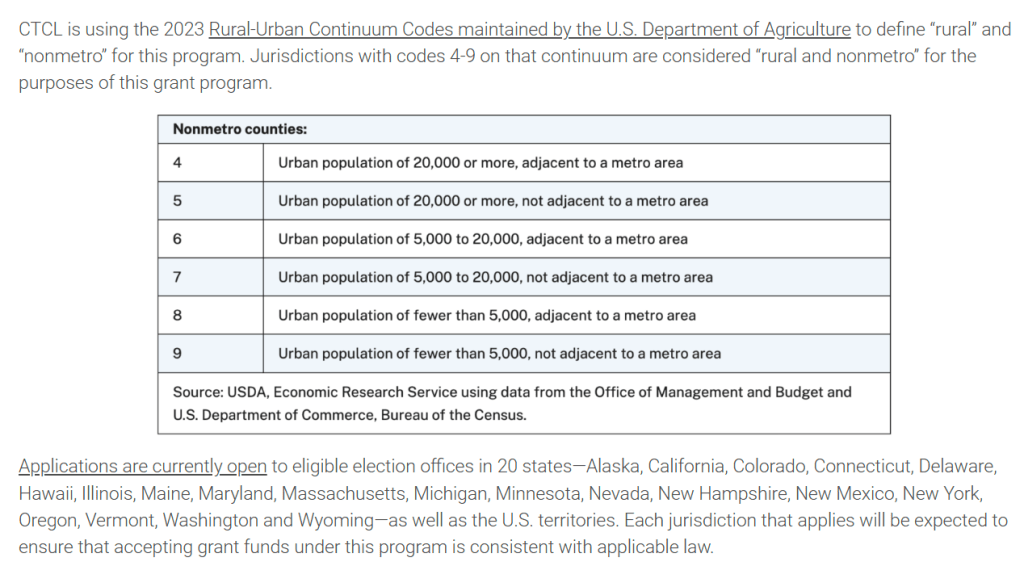
The above data is county-based, and counties do not run Massachusetts elections, so identifying which of the 351 communities are eligible is challenging.
By injecting private funds into public election offices, CTCL is effectively privatizing a critical government function. This raises serious questions about the integrity of the electoral process and the potential for outside manipulation.
While CTCL touts its commitment to transparency, the reality is far murkier. The application process and fund allocation methods remain opaque, with little public oversight. After the 2020 presidential election, a group of Massachusetts volunteer researchers asked cities and towns if they had applied for and received any grants from CTCL, but they received little response. Further digging on town websites proved difficult, as some grants were buried under nondescript file names or rolled into “general grant” reports. Only a few towns volunteered information about their CTCL grants after receiving public records requests.
Why so secretive?
by Citizens for Truth Contributor
Sources:
https://www.techandciviclife.org/our-work/election-officials/grants/2024grants/
https://www.nbcnews.com/politics/2022-election/zuckerberg-money-wont-aid-elections-rcna24002
https://www.naco.org/blog/new-250-million-grant-program-available-local-election-officials
https://capitalresearch.org/article/states-banning-zuck-bucks/
https://www.techandciviclife.org/our-work/election-officials/grants/
https://electionexcellence.org/our-community/
https://www.techandciviclife.org/us-alliance-for-election-excellence-launch/



 Massachusetts First
Leave a reply to markczerwinski Cancel reply