
I wrote an article about the little town of Gosnold on June 30th of this year, describing a surprising statistic I discovered while casually perusing the town’s website. In short, I found that the number of registered voters exceeds the number of residents. If you haven’t read the article, click here.
Since then, I have sent two email requests to the town clerk for information that explains the discrepancy. The first, sent in June, was informal, but after receiving no response, I sent another, more formal public records request in September.

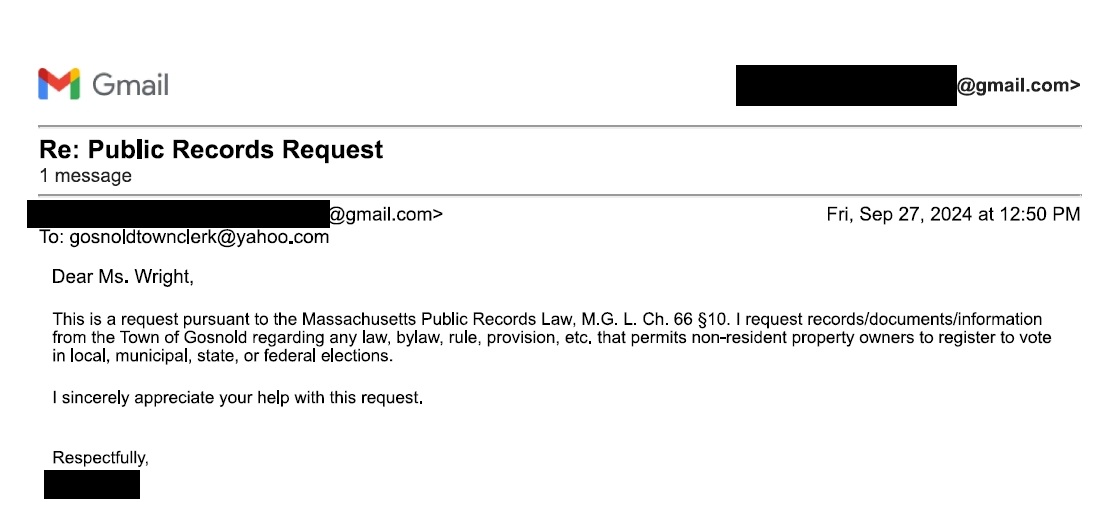
I have received no response. Massachusetts law requires Record Access Offers to respond to Public Records Request within 10 days. I have sent requests to most of the 351 municipalities in the state at one time or another, and some towns don’t respond, but most do. Some require a phone call to see if they received the request. However, I don’t believe someone should have to pester a town to obtain public information, so I haven’t called the office. Sometimes, the municipal email services block Protonmail as spam. But you see above that I sent the second request using Gmail, so that should not be a problem. I may try a 3rd time and follow up with a phone call if I don’t hear back.
This article was not going to be about the responsibilities of towns to be responsive and transparent with the public, but here we are.
Now, let’s move on to some other things about Gosnold.
Gosnold Trivia
Island Ownership
In the previous article, I mentioned that I would share another piece of interesting information about the Commonwealth’s tiniest town. Do you know who owns most of the property on the Elizabeth Islands, of which Gosnold is the largest town?
From Wikipedia:
Gosnold is a town that encompasses the Elizabeth Islands in Dukes County, Massachusetts, United States. At the 2020 census, the town population was 70, making it the least populous town in Massachusetts. Most of the residents live in the village of Cuttyhunk, while most of the land in the town is owned by the Forbes family.
And do you know who is a member of the Forbes family?

Many of you might have already known this, but I didn’t.
Here are some tidbits about the Forbes family’s relationship to the Elizabeth Islands:
The Forbes family has owned most of the Elizabeth Islands since the mid-1800s. Their ownership began when John Murray Forbes, a wealthy businessman who made his fortune in the China trade and railroad investments, purchased Naushon Island in 1842.
The Forbes family owns most of the islands through various trusts and a family corporation. Their holdings include:
– Naushon Island (the largest of the Elizabeths)
– Nashawena Island
– Pasque Island
– Uncatena Island
– Nonamesset Island
– Bull Island
– The Weepecket Islands
– Several other small islands and rocky outcroppings
Out of the 13 islands in the chain, only two are not owned by the Forbes family:
-Cuttyhunk Island: This is a public island with a small town (Gosnold) of about 50 residents.
-Penikese Island: This island has a different ownership history and has been used for various purposes over the years.
As a member of the Forbes family, Kerry likely spent time on these private family-owned islands throughout his life, though exact dates are mostly unknown. However, in 1993 and 1994, while Kerry was a U.S. Senator, he hosted President Bill Clinton and First Lady Hillary Clinton as guests on Naushon Island. The islands have been a private retreat for the extended Forbes family for nearly 200 years.
Public Use
One last little piece of info I discovered while peeking around at Gosnold and the Elizabeth Islands:
It used to be home to a school for wayward boys.
From 1973 until 2011, Penikese Island was home to the Penikese Island School.
From 1973 to 2011, the Penikese Island School, Inc, operated a non-profit private residential school for troubled boys. The school acted as an alternative to juvenile detention, and earned a reputation for its intimate size, quaint setting, and “choice and natural consequences” philosophy, attracting media attention and countless documentaries about the program. The school’s mission served teenage boys who had not recovered in more traditional programs.
You can watch a documentary about it here:
Before that, it was a leper colony.
Gosnold and the 2024 Election
Lastly, let’s go back to Gosnold’s registered voter curiosity. Here is the most recent data from the Secretary of the Commonwealth that pertains to the 2024 Election:
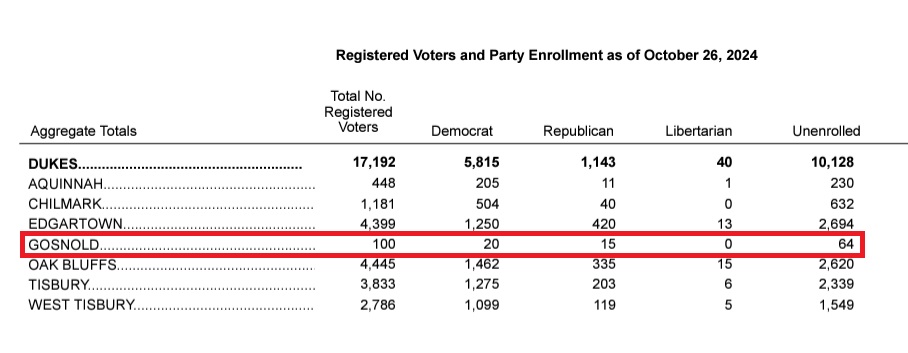
According to a 2022 article in the Boston Globe:
Residents estimate that there are 12 year-rounders on Cuttyhunk (some people have other homes off island but spend the majority of their time on island, so it shifts depending on the week)
According to Perplexity.ai:
Population Trends
Gosnold has consistently maintained its status as the least populated town in Massachusetts. Some key population statistics include:
2020 Census: 70 residents
2022 Estimate: 64 residents
2023 Estimate: 67 residents
2024 Projection: 66 residents
The town has seen a slight decrease in population, with a reported annual decline rate of about 1.49%.
The above is just information, among other information about Massachusett’s tiniest town.
By JLK
Other sources:
https://wbsm.com/massachusetts-elizabeth-islands-off-limits/
https://www.southcoasttoday.com/story/lifestyle/2005/07/24/the-other-islands/50406315007/
https://fun107.com/owner-most-land-massachusetts/
https://www.britannica.com/place/Elizabeth-Islands
https://arlingtonlandtrust.org/visit/elizabeth-island-in-spy-pond/
https://www.pointseast.com/lure-of-the-elizabeths/
https://www.kinlingrover.com/blog/visiting-cuttyhunk-island-and-the-elizabeth-islands/
https://www.wanderer.com/features/a-brief-history-of-the-elizabeth-islands/


 Massachusetts First
Leave a comment