

There can be a degree of difficulty when attempting to distinguish the advantages and differences as it relates to both 504 Plans and Individual Education Programs for students with mental and/or behavioral health disabilities. My goal is to take a detailed look at both IEP and 504 plans, assessing each’s ability to both protect and support students with mental health conditions. By examining the services and assistance each plan provides it should allow for a clear path of choice for students with specific mental health conditions to access and flourish in an academic setting.
What is an IEP?
An Individualized Educational Plan (IEP) is a plan created for a student with a disability which impedes their academic performance and by law requires specialized services, assistance and instruction. The disabilities which are covered under an IEP plan include “autism, blindness, deafness, emotional disturbance, hearing impairment, intellectual disability, multiple disabilities, orthopedic impairment, other health impairment, specific learning disability, speech or language impairment, traumatic brain injury, and/or visual impairment” (Woodworth,2016).
The student receiving the plan undergoes a series of in class observations and testing to decipher the appropriate services and goals which will be provided to aid their special education needs. In some cases, the IEP may require the student to attend a specialized classroom with added staff and dedicated educational instruction. The team which creates the IEP consists of the student’s parent(s), special education and general education teachers, a school adjustment/guidance or psychologist and a school district representative. There are strict guidelines which must be adhered to by those involved with the creation on the IEP.
The IEP team meets within 30 days of the student being determined eligible for services.
Participation includes parents and student as appropriate. The team must include the student’s parent, general education teacher, and the school’s special education teacher. There might be additional members present such as speech teacher, therapist, counselor, or principal. It is uniquely tailored to the student’s needs including instruction, related services (occupational therapy, physical therapy, speech), any assistive technology needs (iPad, keyboard), and any other services to meet the student’s needs related to their disability. Measurable yearly goals, including current benchmark and short-term goals. Goals must be specific, measurable, achievable, and time limited. Services which will allow the student to be included in the general academic curriculum, extracurricular, and other nonacademic time (recess, lunch). If, when, and how the student will participate in state and district testing standards. A behavior plan needs to be in place, if necessary. At the age of 14, the child’s plan must have inclusion of transition services. The cost and availability of these interventions will not determine eligibility. If child is eligible for specific interventions, they must be provided by the school district at no cost, even if provided at alternative locations. The IEP must be formally reviewed annually to determine if the goals set forth have been met, any modifications in academic, placement, or services need to be arranged, or if the student’s disability continues to impact their education (Woodworth, 2016).
IEP Background
In 1975, a federal law was created to ensure that children with disabilities were given the right to free and appropriate public education under the Individuals with Disabilities Education Act. The IDEA, managed by the U.S. Department of Education, oversees special education services provided throughout the United States and assists in funding various special education services provided by state and local agencies.
The IDEA is founded on six important principles outlined by Woodworth (2016). First, local school districts are responsible for providing disabled children between the ages of six through seventeen with an education. Second, it must be comprehensively decided, free of any type of bias, if special education is needed. Third, free education will be provided to the student with a corresponding IEP to describe the child’s needs. Fourth, the student will be provided an educational environment mostly free of limitations and inclusiveness to peers. Fifth, protection of parental rights and consents must be observed. Sixth, both the disabled student and their parents are to jointly be involved in the creation and application of their special education services.
What is a 504 Plan?
The 504 plan was created to provide accommodations which allow for a handicapped student to attain academic success in their learning environment. The 504 plan covers children who suffer from a form of disability which is impactful to their learning environment but not so much so that they are covered under the IDEA. Children who are placed on a 504 plan are generally educated in a traditional classroom setting but are allotted educational tools, services and accommodations to allow for a greater chance at academic success. “The purpose of 504 Plans is to provide services that are specific to the student and allow him or her to participate with same-aged peers to the extent possible in public education” (Spiel, Evans & Langberg, 2014). Some examples of the accommodations provided to students with 504 plans are preferred seating, extended time allotments on assigned work and tests, technological aids, reduced and modified school and homework, verbal testing, occupational or physical therapy groups and behavior management support. The school in which the student attends is responsible for the funding of the 504 plan.
The process in which a student is considered for a 504 plan and in which the plan is set in place is not as arduous and time consuming as an IEP evaluation. “Evaluation draws on information from a variety of sources and is documented. Decisions about the child, evaluation data, and placement options are made by knowledgeable individuals. Such decisions do not require written consent of the parents, only that the parents are notified. Requires “periodic” reevaluation. No provisions made for independent evaluation at school’s expense. Requires reevaluation before a significant change in placement” (Council for Exceptional Children, 2002).
The creation of Section 504
The IDEA does not cover every student with a disability, only the more detrimental cases are considered for its assistance. In an effort to take a more wide-ranging look at constitutional liberties, the U.S. Department of Education: Office of Civil Rights created section 504 of the Rehabilitation Act of 1973 which, now working in tandem with the Americans with Disabilities Act of 1990, protects any person with a disability from unfair treatment in school systems. “Section 504 of the Rehabilitation Act of 1973 prohibits discrimination based on disability in any program or activity operated by recipients of federal funds. Title II of the Americans with Disabilities Act of 1990 (ADA) prohibits discrimination based on disability by public entities, regardless of whether they receive federal financial assistance” (U.S. Department of Education, 2018). Filling in the gaps that the IEP was incapable of encapsulating, a 504-plan allowed for a student with a disability which may not be impacting their education but was still adversely affecting a major life function, the opportunity for assistance in which they most desperately needed.
Qualifications
The qualifications for an IEP or 504 plan are can appear somewhat similar but upon further review are very different from one another. “It is difficult to qualify for special education services and receive an IEP. An IEP requires that a student have a documented disability, but there must be clear data to support that the disability creates an adverse impact on educational performance and that specialized instruction is essential for the child to be successful” (School Psychologist Files, 2016). Having a disability which affects your life but does not overtly affect your ability to learn can often make it more difficult for students with certain mental health concerns to get the services they need.
Disabilities are not always severe enough to be considered for an IEP, which is where a 504 plan may be a more suitable possibility. “To qualify for a 504 Plan, a student must have a disability that affects a major life function. That disability does not have to be one of the categories outlined by the Department of Education. It can be any mental or physical disability. That disability has to impact a “major life function.” Unlike an IEP, a “major life function” does not have to be educational impact” (School Psychologist Files, 2016). A 504 plan allows for a more lenient approach to disabilities and can open up the door for services which could allow a student suffering from less severe disabilities a better chance for success. “[504] plans aren’t part of special education, so they don’t provide individualized instruction, like IEPs do. But a central purpose of 504 plans is to give kids with disabilities access to the same education their classmates are getting” (The Understood Team, 2014).
If a student has an IEP, they generally do not also need a 504 plan (as in many cases there would be a lot of redundancy). Random, unforeseen situations do occur which may lead to two possible exceptions to the rule. Temporary accommodations may be set in place if a student needs temporary assistance due to injury and placing it into an IEP is not needed long term, a 504 plan for that accommodation can be created. If a student has an IEP, a separate 504 plan can be created if a child has a medical condition which does not directly impact learning.
Pros and Cons.
Like anything in life, both an IEP and a 504 plan have their fair share of positive and negative effects. An IEP requires that a child’s disability be a significant reason for their failure to perform well in an educational setting. 504 plans are far broader in how they relate to disability of a major life activity and does not require a special education setting but just the accommodations necessary for potential success in a learning environment. Neither an IEP or a 504 plan requires a cost for service to the family of the student. An IEP and 504 plan can assist a student from grade school to high school with no penalty, as college disclosure is completely in the hands of the student.
IEPs provide individualized special education and related services to meet the unique needs of the child. A student with a disability which adversely affects their education no longer needs to worry about being ostracized for slowing down class productivity or being made to feel “less than” for learning differently than their peers. With an education plan designed to highlight a student’s strengths and assist with their weaknesses, IEPs are an enormous asset and enable those differently abled a chance at an education.
By keeping both the parent and student thoroughly involved in the process through the use of annual meetings, an IEP allows both the opportunity to feel like a genuine part of the process. “The IEP meeting has the potential to humanize the bureaucratic nature of school processes if it places the student and family firmly at the center of the planning” (Cavendish & Connor, 2017). 504 plans provide services and changes to the learning environment to meet the needs of the child as adequately as other students. 504 plans allow a student to remain in a general education setting, while being provided with added accommodations for educational success. A 504 plan is much easier to get than an IEP and has the added benefit of transfer to college if the student feels it would be beneficial.
There are some deficits to both IEPs and 504 plans. IEPs are often viewed as deficit based rather than strength based, which can leave parents apprehensive, feeling as though their child will be stigmatized. IEP meetings can be overwhelming, some parents have become overwhelmed by the enormity of the process, evaluations and frequent meetings. Once a student graduates the IEP ends as well, leaving many students without the supports they need for further education. 504 plans can often be standardly issued and not specific to a student’s needs. 504 plans, they do imply a need for special accommodations which may lead to jealousy or backlash from other students who feel they are unfairly treated. 504 plans can only be attained with parental consent and may not be initiated by the student. 504 plans tend to skew towards white males and people of privilege.
Mental Health Impact & Policy change.
“As of 2015–16, Students with autism, intellectual disabilities, developmental delays, and emotional disturbances each accounted for between 5 and 9 percent of students served under IDEA “(Figure 1., U.S. Department of Education, 2017). The after mentioned graph shows that many with mental health disabilities are being underserved by the IDEA. When looking at the impact both IEPs and 504 plans have on mental health and which plan better serves those in the mental health community things seem to stagger to one side but not without its own share of consequences.
Services may not be an option for some students as getting the assistance an educational plan may provide isn’t always easy. In regards to mental health and the assistance an IEP or 504 can provide, the 504 plan seems to be the best option possible. IEPs are very specific and take a great deal of meetings, evaluations and observations. 504 plans can be less intrusive yet still provide the accommodations necessary for mental health assistance and academic perseverance,
Candidates for IEP and 504 plans are not always easy to spot when it comes to the mental health. Students suffering from emotional disturbances can often feel powerless or embarrassed.
“A Somali-American woman, explained that she had struggled with mental health but her parents failed to acknowledge mental disorder. Her inability to discuss mental health with her parents meant she couldn’t be tested for ADHD or counseled for depression. She explained that she felt deeply uncomfortable telling her teachers that she had missed class or was struggling due to her mental health, and didn’t have a 504 to validate her experience. But 504s require parent involvement, which is a privilege that not all students have.” (Hand, 2018). A policy change, allowing students to advocate for their own needs and educational resources could greatly improve the impact 504 plans could have on the mental health community. Allowing students the opportunity to speak on their own behalf and arrange for educational supports may encourage more people to confront their mental illnesses.
Final Recommendation.
I feel that both the IEP and 504 plans can be a tremendous asset to those who have mental health disabilities. To recommend one plan over the other would require a great deal of understanding of the severity in which the student is afflicted by their disability in a classroom setting. If the student is affected by their disability in such a way that they are unable to handle the course material presented despite various accommodations, it may be necessary to have them evaluated for an IEP. An IEP would allow them to experience a more succinct learning environment in which the course material could be altered and presented in such a way that they would prosper. An IEP could remove the disappointment and frustration of failure if it were designed to work from a strengths-based model that highlights the student’s mental health capabilities. If the student’s mental health disabilities affect their education but do not require specialized instruction and their performance can be further bolstered through a series of accommodations, then a 504 plan would be the most efficient method of aiding their education.
Mental health is not always such a clear picture. I feel that if a policy change were to go into effect allowing students to disclose their needs and apply for a 504 plan, than perhaps the mental health issues which go unnoticed at schools may be addressed more commonly.
Citizens for Truth Contributor
References
Cavendish, W., & Connor, D. (2017). Toward Authentic IEPs and Transition Plans: Student, Parent, and Teacher Perspectives. Learning Disability Quarterly, 41(1), 32-43. doi:10.1177/0731948716684680
Council for Exceptional Children. (2002). Understanding the Differences Between IDEA and Section 504, Teaching Exceptional Children, v.34(3). Retrieved from http://www.ldonline.org/article/6086/
Hand, S. (2018). The Increasing Number of 504 Plans and the Mental Health Epidemic. Retrieved from https://medium.com/@sallyhand13/the-increasing-number-of-504-plans-and-the-mental-health-epidemic-7bdf58220663
School Psychologist Files. (2016). Which is better, a 504 Plan or an IEP? Retrieved from http://schoolpsychologistfiles.com/which-is-better-a-504-plan-or-an-iep/
Spiel, C., Evans, S., & Langberg, J. M. (2014) Evaluating the Content of
Individualized Education Programs and 504 Plans of Young Adolescents with Attention
Deficit/Hyperactivity Disorder. School Psychology Quarterly, Vol 29(4), 452-468
U.S. Department of Education. (2018). Protecting Students With Disabilities. Retrieved from https://www2.ed.gov/about/offices/list/ocr/504faq.html
U.S. Department of Education, Office of Special Education Programs,
Individuals with Disabilities Education Act (IDEA) database, retrieved July 10, 2017,
from https://www2.ed.gov/programs/osepidea/618-data/state-level-data-
files/index.html #bcc. See Digest of Education Statistics 2017, table 204.30
The Understood Team. (2014). The Difference Between IEPs and 504 Plans. Retrieved from https://www.understood.org/en/school-learning/special-services/504-plan/the-difference-between-ieps-and-504-plans
Woodworth, J. (2016, September 10). IEPS, 504 PLANS AND BEHAVIOR CONTRACTS. Retrieved from http://www.eparent.com/military-uncategorized/ieps-504-plans-and-behavior-contracts/
Figure 1. Percentage distribution of students ages 3–21 served under the Individuals with Disabilities Education Act (IDEA), Part B, by disability type: School year 2015–16
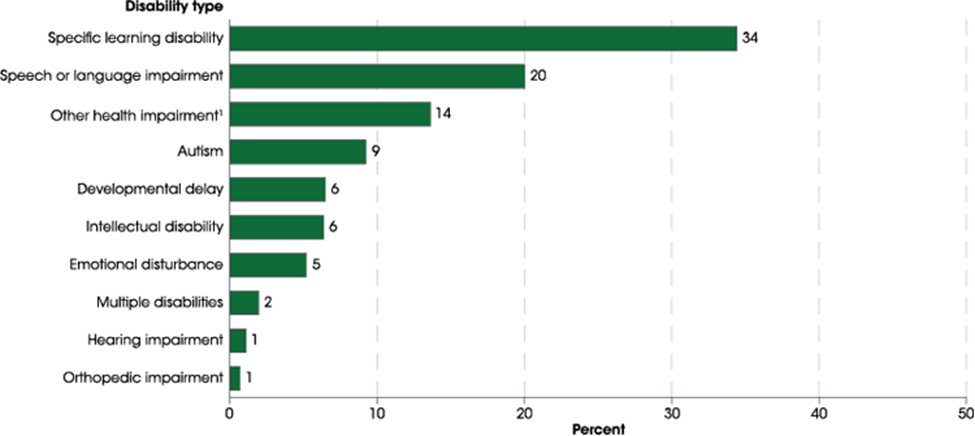
1 Other health impairments include having limited strength, vitality, or alertness due to chronic or acute health problems such as a heart condition, tuberculosis, rheumatic fever, nephritis, asthma, sickle cell anemia, hemophilia, epilepsy, lead poisoning, leukemia, or diabetes.
NOTE: Deaf-blindness, traumatic brain injury, and visual impairment are not shown because they each account for less than 0.5 percent of students served under IDEA. Due to categories not shown, detail does not sum to 100 percent. Although rounded numbers are displayed, the figures are based on unrounded estimates(U.S. Department of Education, 2017).


 Massachusetts First
Leave a comment