

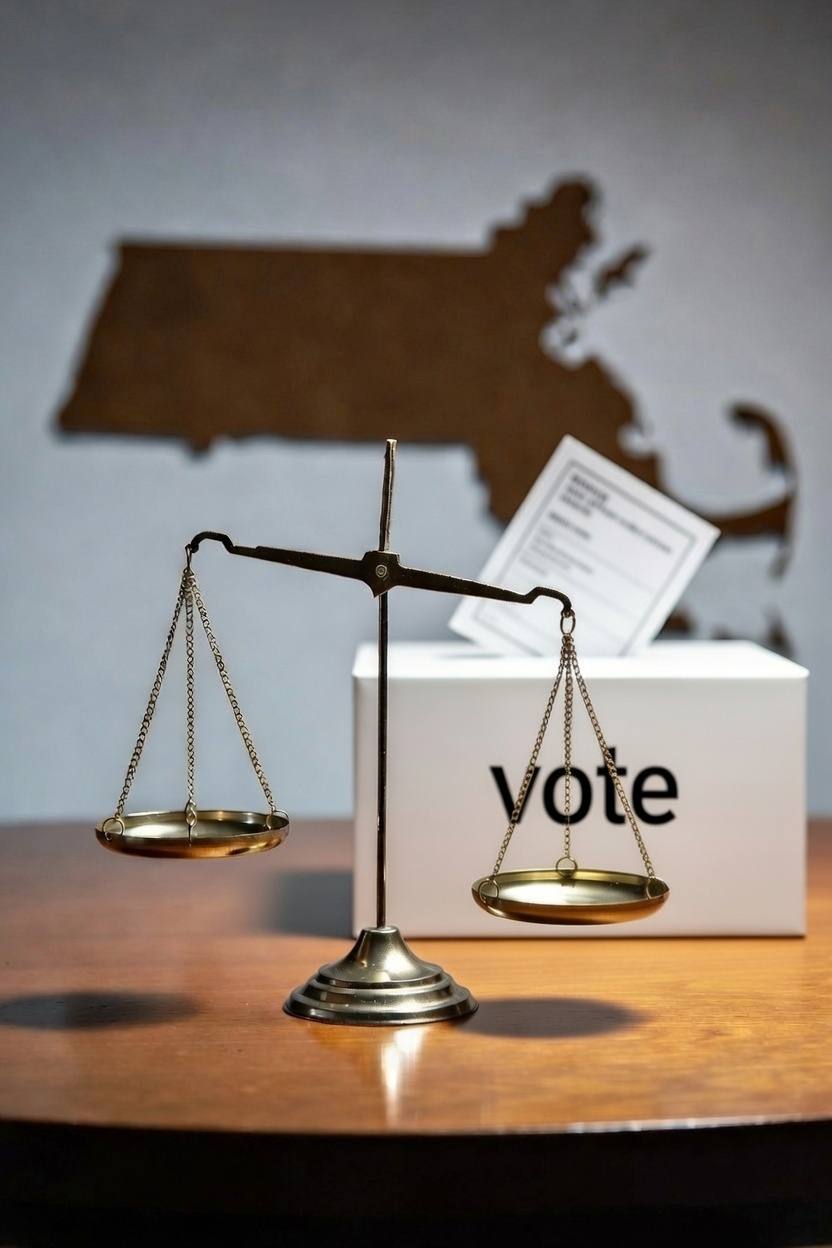
Ranked Choice voting may be on the 2024 ballot in Massachusetts. Voters should understand what it is.
On August 3, John A. Griffin, Managing Partner for Strategy at a non-profit organization (501c3) called Partners in Democracy, filed a ballot initiative for consideration by the Attorney General, 23-04 Initiative Petition for An Act to Establish a Non-Partisan Top Five Election System. Top Five Election System is another word for Ranked Choice Voting. Supporters of this change to how we vote have tried several times in multiple jurisdictions to implement this method and have succeeded in a few Massachusetts municipalities for local elections [1]. However, a similar state-wide initiative failed during the 2020 election despite a high favorability among voters in some municipalities, including the City of Boston.[2]
“A ranked-choice voting system (RCV) is an electoral system in which voters rank candidates by preference on their ballots. If a candidate wins a majority of first-preference votes, he or she is declared the winner. If no candidate wins a majority of first-preference votes, the candidate with the fewest first-preference votes is eliminated. First-preference votes cast for the failed candidate are eliminated, and counting the next-preference choice indicated on those ballots. A new tally is conducted to determine whether any candidate has won a majority of the adjusted votes. The process is repeated until a candidate wins an outright majority”
Ballotpedia.org
I had heard of Ranked Choice Voting (RCV) before but never looked into it. I figured now would be an excellent time to learn about the alternative voting method before making a choice, so I began my learning journey with a (relatively) open mind. I admit my conservative leanings had already nudged me toward the “Anti-RCV” camp. I nevertheless set out to acknowledge my bias and work very hard to find academic sources from both sides, avoiding arguments from voter advocate sites and political parties.
As a result of my investigation, I am confident about how I will vote if the measure makes it to the ballot, but I’ll wait to offer my opinion. Instead, I would like to explore the topic in a series of articles, breaking it down into bite-size pieces to better illuminate how I arrived at my viewpoint. I hope this series will also help you understand the issue better.
Your vote is important! Information is power!
To get started, please watch the three short videos below to understand better how the system works. One “explainer video,” one “pro-RCV,” and one “anti-RCV.” I won’t try to prove or disprove the claims in the videos right now. This is to get a general idea of the arguments before moving on.
Explainer:
pro-RCV ad from 2020:
anti-RCV from The Heritage Foundation:
Don’t make up your mind just yet! There is much more to learn!
Stay tuned for more parts in the series where I will explore:
RCV: How does it work? Does it work?
RCV: Who is behind the ballot initiative?
RCV: An Experiment
RCV: Opinion
by Jana K
Sources:
[2] https://www.masslive.com/politics/2020/11/these-massachusetts-cities-and-towns-voted-yes-on-ranked-choice-voting-ballot-measure-that-failed.html (https://archive.ph/jAgdR)


 Massachusetts First
Leave a comment